Release Date: Sep 22, 2026
An aluminum junction box is a metal electrical accessory specially used for circuit connection, wiring transition, and line protection in electrical engineering, automation equipment, and power transmission systems. It takes high-quality aluminum alloy as the raw material, and is manufactured through die-casting, stamping, CNC finishing, and surface anti-corrosion treatment processes. As a key protective component of electrical wiring systems, the aluminum junction box is mainly used to concentrate, connect, and fix power lines and signal lines, and provides closed protection for internal wiring terminals, effectively isolating external dust, moisture, corrosive gas, and mechanical damage, ensuring the safety and stability of circuit operation. Compared with plastic junction boxes and iron junction boxes, aluminum junction boxes have obvious advantages in mechanical strength, anti-corrosion performance, heat dissipation effect, and service life, and are widely used in industrial workshops, outdoor engineering, new energy power generation, construction electrical, and intelligent equipment fields.
Raw material advantages lay the foundation for the high performance of aluminum junction boxes. Most aluminum junction boxes adopt ADC12 aluminum alloy or 6063 aluminum profile as the main material. ADC12 die-casting aluminum alloy has high hardness, high tensile strength, and good casting performance, which can be molded into complex box structures at one time, with dense material structure and no internal pores, ensuring the overall rigidity and pressure resistance of the junction box. 6063 industrial aluminum profile has excellent ductility, oxidation resistance, and surface flatness, suitable for processing standardized and customized junction boxes with regular structures. Aluminum alloy materials have lightweight characteristics, with a density only one-third of iron and steel, which greatly reduces the overall weight of the equipment during installation, reduces the load of mounting brackets, and facilitates on-site construction and installation. At the same time, aluminum alloy has natural metal ductility, which can resist certain impact and extrusion deformation, and will not be brittle and damaged like plastic boxes.
Anti-corrosion and weather resistance are the core competitive advantages of aluminum junction boxes. After professional surface treatment processes such as anodizing, powder spraying, sandblasting, and electrophoretic coating, the surface of aluminum junction boxes forms a dense protective film. This protective film can effectively isolate air, moisture, acid-base corrosive substances, and salt fog erosion, solving the problems of rust and corrosion of iron junction boxes in humid and outdoor environments. Even in harsh environments such as coastal salt fog, chemical workshops, and rainy and humid areas, aluminum junction boxes can maintain complete appearance and stable structural performance for a long time, with a service life of more than 10 years, which is far longer than plastic and iron junction boxes. In addition, the surface treatment process can realize diversified color customization, which can match different engineering and equipment appearance requirements, improving the overall aesthetics of the project.
Excellent heat dissipation performance makes aluminum junction boxes uniquely advantageous in high-power circuit scenarios. Aluminum alloy is a high thermal conductivity metal material with fast heat conduction and heat dissipation speed. When the internal circuit of the junction box generates heat due to current operation, the aluminum box body can quickly export the heat to the external environment, effectively avoiding heat accumulation inside the box, preventing circuit aging, short circuit, and equipment burnout caused by high temperature. This heat dissipation advantage is particularly prominent in high-power electrical equipment, new energy photovoltaic power distribution, and industrial high-current wiring scenarios, which can effectively improve the safety and stability of circuit operation and reduce the failure rate of electrical equipment.
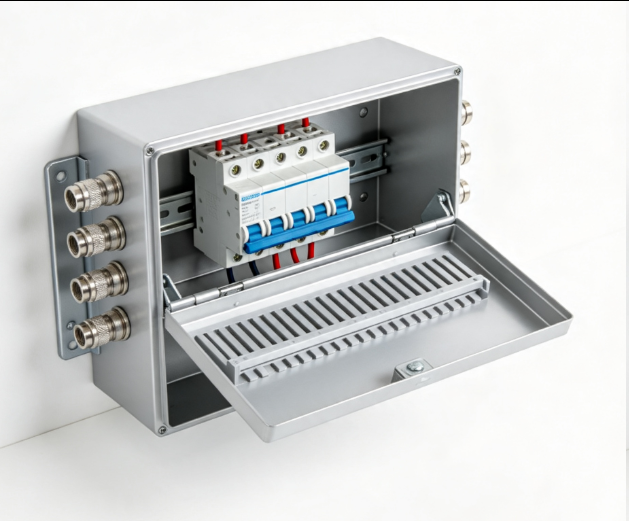
In terms of structural design and functional performance, aluminum junction boxes adopt modular and sealed design. The box body is equipped with precision sealing grooves and high-quality rubber sealing gaskets, which can realize IP65, IP66, and even IP67 high-level dustproof and waterproof protection, completely isolating external dust, rainwater, and impurities from entering the box. The box cover is fixed with stainless steel bolts, with tight assembly and good sealing performance. The internal space of the box is reasonably planned, with reserved wiring holes and terminal fixing positions, which is convenient for wiring arrangement and fixed installation. Some customized aluminum junction boxes are also equipped with waterproof cable connectors, grounding devices, and wire arrangement brackets, which further optimize the wiring safety and convenience. In addition, the metal box body has certain electromagnetic shielding performance, which can reduce external electromagnetic signal interference to internal signal lines and improve the stability of equipment signal transmission.
The application scenarios of aluminum junction boxes cover industrial and civil electrical engineering fields. In industrial automation, they are used for internal wiring and signal connection of automation equipment, sensors, and control systems, adapting to industrial dust and humid working environments. In new energy fields such as photovoltaic power generation and wind power generation, aluminum junction boxes are used for power distribution and line transition of power generation equipment, relying on outdoor weather resistance and heat dissipation performance to ensure long-term stable operation of new energy power systems. In construction electrical engineering, they are applied to outdoor wiring, building facade wiring, and underground wiring protection, solving the problem of easy aging and damage of plastic junction boxes in outdoor environments. In municipal engineering and traffic facilities, they are used for wiring protection of street lamps, traffic signal equipment, and monitoring equipment, with strong environmental adaptability and low maintenance cost. With the continuous development of industrial intelligence and new energy industry, the market demand for high-strength, high-protection aluminum junction boxes is constantly expanding.